Four-Way Coordination Made Easy
What To Practice Before You Sit Behind the Skins
Every (good) drummer requires solid four-way coordination and, whether you're a pro with coordination problems or you're just learning to play, some of the best coordination exercises have nothing to do with the drum set.
Few of us are lucky enough to be born ambidextrous (meaning we can use our right and left limbs equally well). Most of us are either naturally right-handed and right-footed or left-handed and left-footed. Some of us are left-handed but right-footed and vice-versa. But whatever your natural predisposition, ambidexterity is not difficult to learn – if you know a few simple tricks. The exercises that follow can be practiced anywhere, no drum set required.
All You Gotta Do is Act Unnaturally
If you're naturally right-handed, use your left-hand. If you're left-handed, use your right-hand. For what?
For almost everything that you normally do with your natural hand! Well, I wouldn't recommend shaving or
wielding any dangerous weapons with your weak hand. Start with the easy, safe stuff. You can do things like
opening doors, eating an apple and peeling a banana with your weak hand. You can play cards holding the deck
in the opposite hand. You should also try writing, just don't expect anyone to be able to read it! Not at
first, anyway. Try throwing a baseball with your weak hand, shooting marbles, tennis or bowling (providing
you're not playing for the championship).
Retrain Your Brain
Don't let yourself become discouraged when trying to replace your strong hand with your weak one. It takes
time to develop the same degree of coordination in either hand. If you practice regularly, you should start to
see results in a few weeks. The longer you practice, the easier it gets. The pathways between your brain and
the muscles that control your natural hand have been in place since you were a small child. What you have to
do now is retrain your brain, causing it to build new pathways for signals to travel between it and the
muscles of your weak hand.
Don't Forget the Feet
While developing your weak hand, don't neglect your weak foot. You can practice kicking a football or hoping
on your weak foot. If you're into martial arts, concentrate your kicking practice on your weak foot (besides
becoming a better drummer, you'll become a better martial artist as well). If you normally grab your right
foot first when tying your shoes, reverse it. Start with the left. I don't recommend anything dangerous like
driving a car with your weak foot but if you think about it, you'll find lots of safe things you can do.
Again, don't get discouraged. It takes time to retrain your brain.
Are You Ready for the Drum Set?
The more you practice retraining your brain using the previous exercises, the easier it'll be to develop
four-way coordination at the drum set. Read on, for some valuable drum set coordination tips, tricks, and
exercises.
Exercises for the Drum Set
Take a look at the first exercise in the table below. If you have problems playing this, apply the 15-step
process that I explained in my previous articles, The Secret to Four-Way Coordination, parts one and
two. (See the "Related Links" sidebar.) This will help you with any problems you may encounter with
any four-way coordination patterns.
You'll notice that each of the eight exercises below is written using R, for Right Stick or Right Foot, and L
for Left. When you practice, play each separate exercise as if each note were a quarter note in 4/4 time. This
gives you four bars in each exercise. (If you're not familiar with music terminology, refer to Tiger
Reading 101, 102, and 103 in the "Related Links" sidebar.)
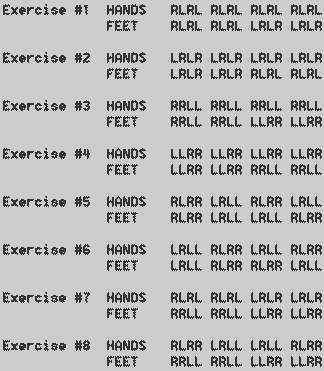
Practice each of the eight exercises separately until you can play them easily. Then try moving from one to the next without stopping or losing the tempo. Always practice your exercises in strict tempo. This will prepare you for playing with an actual band where you'll not only need to have a good solid tempo yourself, but you'll often have to nail it down to prevent other band members from slowing down or speeding up.
Variation is the Name of the Game
After you get good at playing the above exercises, I suggest you create your own variations for further
practice. Use your own sticking patterns or take them from the first few pages of George Stone's Stick
Control. (If you don't already have Stone's classic book, you should get it.) You'll also find these
and many other exercises to help build your four-way coordination in my book, DoubleDrum: A Double Bass Drum Text (For more examples, see
my articles on how to Build Your Double Bass Chops in the "Related Links" sidebar.
Remember, once you've built the pathways to your less-used limbs, four-way coordination will become much easier and more fun to play. It just takes some time and practice.
Until next time: Stay loose.
Tiger Bill's Classic book DoubleDrum: Anniversary Edition is now online. Click for your copy.