
Pro Drummer Secrets: Buddy's Bag
Part Two
Buddy's Triplet Fill-Ins
In part one I showed you how to develop Kick Drum Substitutions, one of Buddy Rich's favorite solo and fill-in techniques (see Part 1 of Pro Secrets: Buddy's Bag in the Related Links sidebar.) This time, more secrets from Buddy's bag of tricks.
Another favorite technique of Buddy's was to take an existing rhythmic line and play it with his left stick on the Snare and then fill-in the remainder of the rests with eighth-note triplets played on the Kick Drum or vice versa. This is something that Buddy did extremely well. Where most drummers threw in a cut or two occasionally, Buddy would constantly interact with the soloist and other band members. Sound complicated? It's really not, once you understand how it works. This powerful "fill-in" technique not only gives you a multitude of Drum solo possibilities, it allows you to "fill-in" behind other soloists in the band, adding another level of excitement to your music. Once you study the exercises that follow, you'll understand exactly how Buddy accomplished this exciting interaction. And with practice, it will become second nature. Here's how to develop this powerful technique.
Start with a book like Ted Reed's Progressive Steps to Syncopation for the Modern Drummer or something similar. You can use any book that contains quarter and eighth-note syncopated patterns like the exercises in my example below.
Jazz Interpretation
Before you can begin to practice the exercises that will help you develop Buddy's fill-in technique, you must
be able to read simple quarter and eighth-note syncopated rhythm and you need to be familiar with something
called "jazz interpretation." If you're having trouble reading music, refer to Tiger Reading
101 through 103 under the Related Links sidebar.) For an explanation of jazz interpretation, read on.
There are two ways to interpret any rhythmic part in drum music. You can either play it straight as written, or use jazz interpretation. Look at the first example in Exercise 1 below. When played straight, it would be counted and played 1 an 2 3 4. But when played using jazz interpretation, all straight eighth-notes become eighth-note triplets. Specifically, the first and last notes of an eighth-note triplet. (If you not sure what an eighth-note triplet is, it's simply a group of 3 notes –written with a 3 above the note group – that are played in the same time that it normally takes to play 2 normal eighth-notes. So one eighth-note triplet equals two eighth-notes. See the second example under Exercise 1 for the result of jazz interpretation. You now count and play 1 (trip) let 2 3 4. With the "trip" being the rest. And that in a nutshell, is jazz interpretation.
Whenever you read a jazz or swing drum chart, straight eighth-notes are always interpreted as triplets. (Stay tuned for a future article with more details on interpreting Drum Charts.)
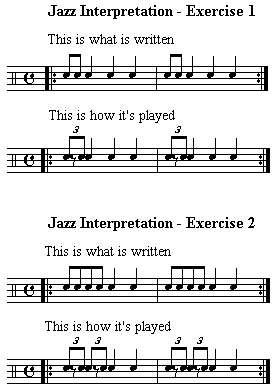
Once you understand how to apply jazz interpretation to quarter and eighth-note syncopations like the examples
shown, you'll be ready to learn Buddy's fill-in technique.
Are you ready? Let's go.
Buddy's Triplet Fill-ins
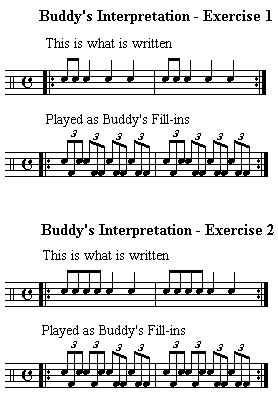
Using what you have just learned about jazz interpretation, take a look at Buddy's Interpretation of Exercise
1. The first example is written "straight" as it would appear in the actual music. The second
example under Exercise 1 not only uses jazz interpretation to convert the feel of the exercise from straight
to swing, but fills-in all of the rests with eighth-note triplets.
In addition, as you'll notice if you compare the first and second example under Exercise 1 carefully, the rhythm in the first example is played with your left stick on the Snare Drum, while the "filled-in" triplets are played on your Kick Drum. Do you get it?
Look at Exercise 2. Compare the jazz interpreted version against the straight eighth-note version. Now look at Exercise 2 under Buddy's Interpretation. Again, compare the way it is written to the way Buddy would have interpreted it. He would first apply a swing or jazz interpretation feel to the written notes, and then he would have filled-in the remainder of the measure as if it consisted entirely of eighth-note triplets. Finally, he would have played the original rhythm part with his left stick on the Snare and filled-in the remaining triplets with his Kick Drum.
Buddy played many variations of this Triplet Fill-in exercise. Sometimes he would reverse this procedure and play the written part on his Kick Drum and fill-in the remaining eighth-note triplets with his left stick on the Snare. Try practicing the two examples I have given you using both ways.
Another variation that Buddy used was to play the written notes with his right stick on the Snare or Tom, and play the fill-in triplets with his left stick on the Snare Drum. He would also mix it up, as follows. Play the written part of the first bar of Exercise 2 under Buddy's Interpretation using your right stick on a Tom and play the additional fill-in triplets with your left stick on the Snare. Then, when you get to the second bar of Exercise 2, switch and play the written part with your foot on the Kick Drum and fill-in the additional triplets with your left hand on the Snare.
Yet another variation is to play a steady right hand "swing" pattern on your Ride Cymbal while playing the written part on your Snare with the left stick and the triplet fill-ins with your foot on the Kick Drum. And you can also reverse the parts that your left stick and Kick Drum play. As you can imagine, there are many variations of this cool exercise.
The best way to develop Buddy's Triplet Fill-in Technique is to get a book that contains quarter and eighth-note syncopated rhythmic patterns, like Ted Reed's Syncopation or Louis Bellson's Modern Reading Text. Take each exercise and apply jazz interpretation while filling in the "missing" eighth-note triplets as explained above. With these exercises under your belt, you'll be well on your way to expanding your drumming technique to a whole new level.
Until next time: Stay loose.
Click the following link for Part 1 of Pro Drummer Secrets: Buddy's Bag!