
Tiger Reading 102
Part Three: How to Read Drum Music
This is the third installment in a continuing series of articles designed to improve your drum chart reading and interpretation skills. Before you begin, you might want to review what we covered in the first two segments, Tiger Reading 101 and 102 (see sidebar). You'll need them for the exercises that follow.
Reading Drum Charts
Sit down at a drum kit or practice pad, and read through the exercise that follows. You should practice
counting all sixteenth notes (even when you're playing eighth notes), and try to follow all repeat signs.
Don't worry, initially, about playing the written drum part to perfection. You can always work on the
three-way coordination needed for that later. The ability to follow the written repeats accurately (without
getting lost) is the most important part of this exercise. Try it.
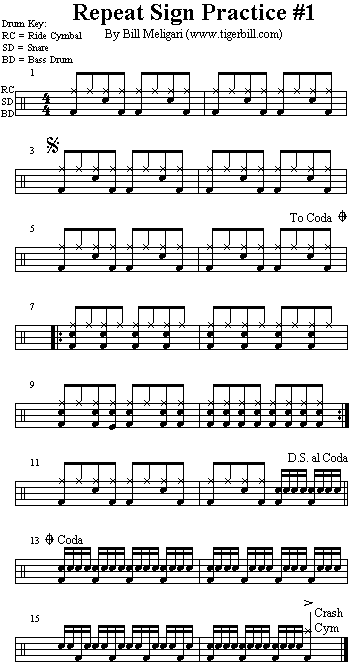
Did you make it through that drum chart okay? Here's how you should have done it:
- Start playing the exercise at measure one. At the beginning of the third measure, take note of the sign, but keep reading and playing. (Try to remember that this measure contains the sign. You'll need it later.)
- When you get to the sixth measure take note of the Coda, but keep playing for now.
- In measure seven, notice the repeat sign (with the dots on the right side).
- When you finish playing the tenth measure, the repeat sign with the dots to the left of the double bar tells you to go back to the repeat sign with the dots to the right of the double bar (measure seven).
- Repeat measures seven through ten.
- The second time you reach the repeat sign at the end of measure ten, disregard it, and play measure eleven and twelve.
- The "D.S. al Coda" in measure twelve tells you to go back to where you first saw the sign (measure three, remember?) and repeat measures three through sixth. When you reach the sixth measure this time, the Coda tells you to jump down to the next Coda in the song (at measure thirteen) and play until the end (measure sixteen). Note that the only difference between a "D.S. Al Coda" and a "D.C. al Coda," (not shown in this example) is that a DC tells you to repeat the song from the beginning, instead of from the sign. Everything else remains the same as in the example above.
More Repeat Sign Practice
This next exercise reviews the remainder of what we learned in "Tiger" Reading 101 and 102
(see sidebar). Like the first exercise, it's more important to learn to count (in this case, count all
sixteenths notes even when you're only playing eighth notes), and follow all repeat signs. Don't worry about
playing all the actual drum chart notes to perfection for now. You can work on that later. (If you're having
trouble with your coordination, see The Secret to Four-Way Coordination in the sidebar for tips on
improving it.)
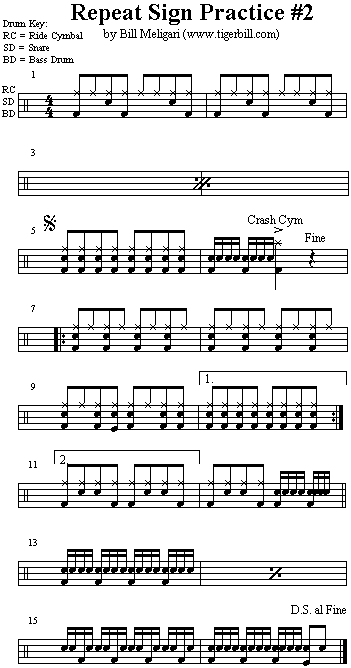
How did you do on this one? Here's the correct way to follow the drum chart:
- Start playing the exercise at measure one. When you get to the third measure, the repeat sign means that you must repeat the previous two measures.
- In measure six, take note of the location of the Fine sign, but keep on playing.
- Take note of where you see the repeat sign (with the dots on the right side) in measure seven.
- When you finish playing the tenth measure, you've completed the first ending. The repeat sign with the dots to the left of the double bar now tells you to go back to the repeat sign with the dots to the right of the double bar (measure seven), and repeat measures seven through nine.
- The second time you reach the first ending (measure ten) skip over it and play the second ending (measure eleven).
- Play measures eleven through sixteen.
- The sixteenth bar contains a "DS al Fine" sign, which means to repeat back to the sign.
- The "D.S. Al Fine" in measure twelve tells you to go back to where you first saw the sign (measure five), and repeat measures five and six (for the second time). When you reach the sixth measure this time, the Fine tells you to stop. Note that the only difference between a "D.S. Al Fine" and a "DC al Fine," is that a DC tells you to repeat the song from the beginning, instead of from the sign. Everything else remains the same.
Practice Makes Perfect
Just as it takes writing every day to become a good writer, so it takes reading drum charts every day to
become a good reader. Even if you only have a few minutes each day, use them to practice your reading. Your
drum chart reading skill will improve in no time at all.
Until next time: Stay loose
Click the following link for Tiger Reading 101!
Click the following link for Tiger Reading 102!