
Rudiments Around the Drums: Part 3
Not For Marching Only!
In my two previous articles on this subject (See the Related Links sidebar), I gave you some ideas for applying the Single Stroke Roll, Double Stroke Roll, Single and Double Paradiddle, Flam and Flam Tap to the Drum Kit. This time, I'd like to play around with the remainder of the Rolls that belong to the Standard Rudiments. Remember, these are simply ideas for you to use as a starting point to develop your own approach to applying Rudiments around the Drums.
Rolls: Open or Closed?
There are two ways to play a roll, open or closed. To play an Open Roll, you execute each distinct tap R R L
L. To play a Closed (or Buzz) Roll, you apply slight finger pressure on the stick to cause it to bounce
multiple times. This creates a "buzz" sound on the Drumhead. A good Closed or Buzz Roll is developed
by overlapping the buzz of one stick into the buzz of the next. This produces a smooth, continuous buzz sound
that should eventually sound like you're tearing a sheet of sandpaper. While you should practice your rolls
using both methods, the exercises that follow use Open Roll sticking.
Five-Stroke Roll
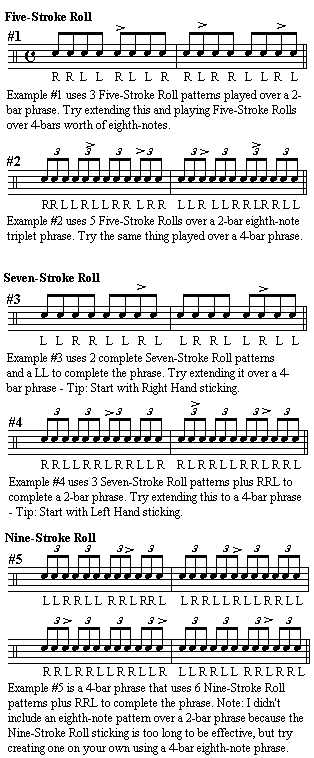
This Rudiment is made up of two Double Strokes followed by an accented Single Stroke and is played with
alternating sticking. You should perfect exercise number 1 and 2 below on a single Drum before you attempt to
apply them to the Kit.
Seven-Stroke Roll
This one is made up of three Double Strokes followed by an accented Single Stroke. In example 3 at the bottom
of this page, you'll notice that the sticking always begins with the left. To avoid becoming one-sided,
practice starting with the right stick as well. The opposite is true for example 4. Perfect these two examples
on a single Drum before you apply them to the entire Kit.
Nine-Stroke Roll
This one is made up of four Double Strokes followed by an accented Single Stroke and the sticking alternates
like that of the Five-Stroke Roll (See example 5 below). When you get to the Practice Ideas section, you'll
see that the accent on the Five-Stroke, Seven-Stroke, and Nine-Stroke Rolls is what produces such a great
sound when these Rolls are played around the Drums.
Practice Ideas
Once you are comfortable playing each of the five examples above as written, apply them to the entire Drum Kit
as follows:
- Play all accents on Tom-toms and unaccented notes on the Snare, while playing the Kick Drum on beats 1 2 3 4 and the Hi-Hat on 2 and 4 (with your foot).
- Play all accents on your cymbals along with the Kick Drum, while playing the Hi-Hat on beats 1 2 3 4 (with your foot).
- Same as #1 above, except play all unaccented sticking between two Tom-toms (one for each hand) and accents on the Snare.
- Make up your own.
Ten-Stroke Roll
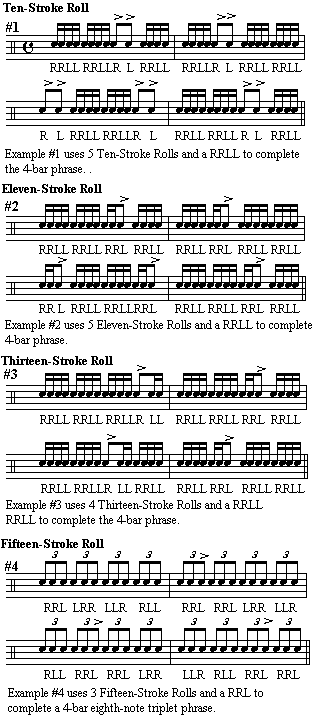
This Rudiment, the only even-numbered Roll in the Standard 26, consists of four Double Strokes followed by two
Single Strokes. Officially, only the second Single Stroke is accented but it also sounds good to accent both
of the Single Strokes. Although the sticking always begins with the left, to avoid becoming one-sided,
practice starting with the right stick as well. Check out examples 1 and 2 below.
Eleven-Stroke Roll
This one is made up of five Double Strokes followed by an accented Single Stroke. Even though the sticking
begins with the left, practice starting with the right stick as well. See examples 3 and 4 below.
Thirteen-Stroke Roll
This one consists of six Double Strokes followed by an accented Single Stroke and the sticking alternates like
that of the Five-Stroke and Nine-Stroke Roll. Practice example 5 below.
Fifteen-Stroke Roll
The last Roll I want to cover this week consists of seven Double Strokes followed by an accented Single
Stroke. See example 6. The sticking alternates like the Five-Stroke, Nine-Stroke, and Thirteen-Stroke Roll.
Like all the Rolls in this lesson, the accent adds a complicated sound to what are basic Rudimental patterns,
as you'll see when you apply them to the Drum Kit using Practice Ideas.
Practice Ideas
Once you are comfortable playing each of the five examples above as written, apply them to the entire Drum Kit
as follows:
- Play all accents on Tom-toms and unaccented notes on the Snare while playing the Kick Drum on the beats 1 2 3 4 and the Hi-Hat on the beats of 2 and 4 (with your foot).
- Play all accents on a cymbal along with the Kick Drum, while playing the Hi-Hat on beats 1 2 3 4 (with your foot).
- Same as #1 above, except play all unaccented sticking between two Tom-toms (one for each hand) and accents on the Snare.
- Make up your own.
That's it for now. We'll cover Ratamacues in part 4 of Rudiments Around the Drums.
Until then: Stay loose.
Click the link for Rudiments Around the Drums: Part 4