
Rudiments Around the Drums: Part 5
Not For Marching Only!
I hope this series of lessons on applying Rudiments Around the Drums has given you some new ideas and sparked some ideas of your own. This fifth, and final, lesson in the series covers Triple Ratamacues and combinations of Rudiments.
Open or Closed
Let's take a look at the Triple Ratamacue.
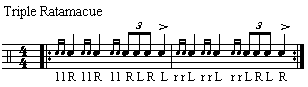
The notation above is the standard version and there are two ways to play the grace notes (which are the 2 small notes preceding the eighth-note triplet). Marching style most often uses the open style, where you play 2 distinct grace notes. Orchestra or Jazz drummers, however, usually play the grace notes closed with a short buzz sound. Either way you interpret the grace notes, you can spread the Triple Ratamacue around the drums in many ways: Play it as is on a snare or tom, break it up and play the grace notes on the snare and the remaining notes on a tom or vice versa. You can also get some good sounds by playing Triple Ratamacues with one stick on the ride cymbal and the other on a snare or tom.
Hip Triple Ratamacue
Another way to spread Ratamacues around the set is to give the grace notes the same time value as the other
notes in the Ratamacue. Take a look at the example below.
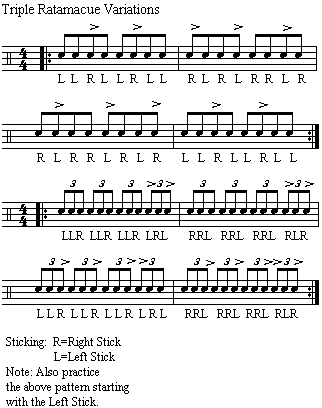
You can play this new version of the Triple Ratamacue around the set as follows:
- On a snare drum or tom, as written.
- Play all accented notes on your toms and all unaccented notes on your snare drum.
- Play all right stick parts with your kick drum foot and left stick parts with your left stick on the snare or tom.
- Same as #3 but also play the right stick part with your right stick on the cymbal along with the kick drum.
- ? Come up with your own way.
Combinations of Rudiments
Although I didn't get the chance to show you each of the 26 Standard Rudiments applied around the drumset in
this series, I've given you enough examples of the different types for you to apply them on your own. For
instance, once you understand how to play a Flam on the kit, which we covered in part 2 of this series (see
sidebar), you can apply "any" Flam-type rudiment in a similar way. The same thing goes for Rudiments
that use Paradiddles, Ruffs, Drags, etc...
Once you perfect each of the Rudiments around the drums separately, the final step is to combine them.
Here are some ideas for combining rudiments and playing them around the drums. They are designed to get you started. I'm certain that, with a little practice, you'll come up with many of your own.
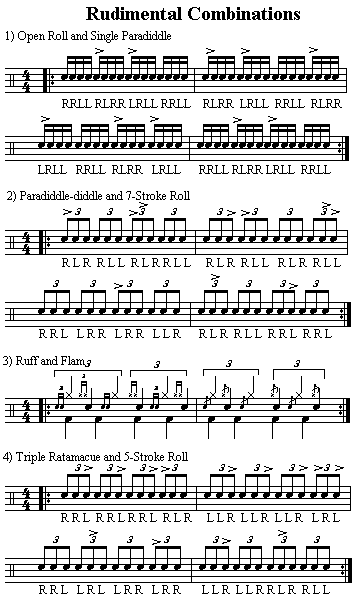
Practice the above exercises in these ways:
1) On a snare drum or tom, as written.
2) Play all accented notes on your toms and all unaccented notes on your snare drum.
3) Play all right stick parts with your kick drum foot and left stick parts with your left stick on the snare
or tom.
4) Same as #3 but also play the right stick part with your right stick on the cymbal along with the kick
drum.
5)? Come up with your own way.
When first practicing the above exercises, you should follow the written repeat signs. After you've become comfortable with them, play some "time" between each exercise. If the example is four bars long, then you'd play four bars of time, the four bar example, and then repeat that pattern. You'll notice that the first example lends itself more to Rock, Funk, or Latin style fills, while the others fit more into the Jazz vein. Be sure to play the appropriate "time" when practicing.
Be Creative
The goal of Rudiments Around the Drums was to give you ideas on how to combine and apply various combinations
of Rudiments to the drum set. I hope I've sparked your creativity enough to get you started on your own path.
If you missed any of the prior articles or want to refresh your memory, you'll them listed in the Related
Resources sidebar on this page.
Until next time, be creative and stay loose!
Click the link for Rudiments Around the Drums: Part 1
Click the link for Rudiments Around the Drums: Part 2
Click the link for Rudiments Around the Drums: Part 3
Click the link for Rudiments Around the Drums: Part 4