

Tiger Bill Reviews
Drum Tuning Sound and Design... Simplified
By Bob Gatzen
DVD
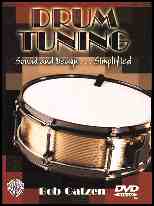
Bob Gatzen is a well-known sound and product designer who has developed, and continues to develop, innovative drum products such as the DrumFrame and, more recently, springless/hingeless kick drum and hi-hat pedals for the DW Drum Company. In addition, Bob has produced the Inspiring Drummers video series (see the sidebar).
Bob's new DVD includes his original best-selling video called Drum Tuning: Sound and Design, which is 95-minutes long, plus an hour of new footage featuring his Simplified method of drum tuning. I've always been a big fan of Bob's work so as soon as I got this DVD, I had to check it out - in detail.
Love Those DVDs!
The main menu contains the following options: Play All, Drum Tuning Sound and Design, Drum Tuning Simplified,
Special Techniques, Special Features, and DVD-ROM Features. If you haven't yet taken the DVD plunge, I highly
recommend you do so. DVD players can now be purchased as inexpensively as VHS machines and, for training
purposes, DVDs are far superior. Instant access to specific chapters, fast forwarding and reversing through
material at high speeds with no wear and tear on the DVD, etc. Plus, you usually get lots of extra bonus
material that the videotape versions lack. Cool!
Drum Tuning: Sound and Design
This segment of the DVD covers basic and advanced methods of tuning your drums, and includes quick and easy
methods for verifying the quality of the drums themselves. (This video was filmed in Bob's own home studio:
Redeyes Studio.)
Introduction
Bob gets a chance to stretch out and plays a tune that proves, in addition to being an inventor of innovative
drum gear, that he is a drummer with chops, taste, and imagination.
According to Bob, "Your drums should never be an obstacle to playing music" and that's the reason behind this entire video. In the chapters that follow, Bob covers three major elements that contribute to overall drum sound:
Element #1: The shell and components = timbre.
Element #2: Heads and tuning = tone.
Element #3: Suspension.
Tom Tom
"Any sound can be a good sound. The only bad sound is a sound you don't want! Once you learn how to tune
a tom, the other drums in your kit will be much easier," says Bob. He then advises us to choose drums
based on sound and feel as opposed to the type of wood they're made from. Covered are details about drum
shells and how various types of shell designs affect the ability of the shell to vibrate freely.
Basic Tuning
According to Bob, this is the most important part of the video because it's the one you have the most control
over. He recommends starting with the middle size tom on your kit and using two new single ply heads for this
initial test (even if you don't normally use them on the drum) because they will help you find the entire
tuning range of your drum.
Included are troubleshooting tips and instructions detailing how to fix most of these problems yourself. Extremely valuable when you're a working drummer out on the road.
And here's something I never realized. When checking a drum hoop for trueness, you should never use a glass table top because most glass tops are NOT flat! (You can stop using glass counter tops to roll-test your drumsticks now!) Formica tops are much flatter. Bob also covers his two-key tuning method along with his special technique for instantly "seating" a drum head, using a hand-held hair dryer.
Tuning Regions
Bob goes into detail on his Regional tuning method, which helps you find the number of 'regions' in a
particular drum. He explains that drums have differing numbers of regions, from one to eight or more. The goal
in regional tuning is to bring the drum up to its specific areas of natural vibration.
Covered are specific tunings that you can use if you're looking for more attack and less sustain and for a more open sound. I like the little trick that shows how to quickly test whether your suspension system is adversely affecting the sound of your drumheads, as far as allowing them to vibrate freely in 'phase' with each other.
Quick Tuning The Entire Drumset
In this chapter, Bob gives us a quick way to get the entire drumset in tune by locating the 'magic' lug.
Snare Drum
The 'signature' drum of the drumset is covered in detail including differences in tuning methods between tom
and snare drums, the effects of lug count on drum sound, shell depths, snare strainers, how snare sensitivity
is affected by the thickness of your snare head, and more.
Applying the Snares
Bob shows how to properly install snares and explains why ropes are better to use than straps for holding
snare wires against the head. Tuning top and bottom heads in intervals of 3rds, 4ths, or 5ths are recommended
for best snare sound.
Bob warns against tightening the basket of your snare stand on the drum due to its dampening effect on the sound. The drum should simply rest on the stand.
Bass Drum
Bob considers the bass drum the second most important drum in the kit and the easiest of all the drums to
tune. The primary goal of tuning the bass drum is to attain the primary pitch and low frequency. He also
demonstrates various methods of muffling the bass drum.
"Two-ply heads provide a sharp attack and a tight low-end where single-ply heads give you a smoother attack with a maximum low end." According to Bob, there are single and dual vibrating systems with bass drums. If you use a front head with a hole in it larger than 6-inches or place any size hole in the center of the front head, this will cause the head to stop vibrating and give you a single vibrating system. Whereas using two solid heads or a front head with an off-center hole in it, will produce a dual vibrating system.
For the best bass drum sound, Bob warns against mounting toms on the bass drum. The bass drum should also be mounted evenly on the floor from front to back as opposed to being tilted.
That concludes the "Drum Tuning and Design" section of the DVD, which was originally produced in 1994.
Drum Tuning Simplified
Bob developed the tips in this new section through a combination of the feedback he received from drummers
after his first tuning video (see the previous section) and his own experience tuning drums in noisy
conditions, such as often occurs backstage. Covered are Bob's sight and touch tuning techniques, which are
great additions to the more common 'sound' method.
Bob's Key Facts to Drum Tuning
Equal Pressure, Symmetry, and Know Where Your Drum Is At.
Troubleshooting
Tips for verifying the roundness of your drum shell, bearing edge alignment, properly designed drumheads,
round drum hoops, correct alignment of tension rods, and 'tap' testing drumheads. Bob strongly recommends that
you perform these tests prior to trying to tune your kit, as the results of the tests will give you a good
idea of how successful your tuning will be!
Head in the Hat
Wearing a simple hat, Bob gives us an example of the proper approach to drumhead tuning. Not to be overlooked
is the importance of owning a good drum key.
The Bass Drum
Bob says you should pay most attention to the drums you hit the most, which are the bass and snare. And I
agree. He then takes us through the installation of a new drumhead using his touch tuning, eye tuning, and ear
tuning methods. Muffling techniques and batter head protection patches are added for that finishing touch.
The Drumhead Factor
If you "know where your drum is at," the only variable that remains is the drumhead. This chapter
explains how to choose, use, and maintain drumheads for optimum sound.
The Snare Drum
Bob applies his touch tuning method to the snare, saying that he can tell if a snare is tuned too high or low
just by pressing into it with his thumb. Eye tuning and ear tuning follows, along with the effective use of
mufflers to cut down on snare buzz.
How to Listen
In this chapter Bob describes two methods of listening while tuning your drums: Specific listening and total
listening, which Bob claims is more useful than the specific type.
Toms
"If you want to learn to tune drums, learn to tune the toms. Touch tuning works great." Following a
demo of touch tuning, Bob shows us how to use eye tuning to find out if that wrinkle in our drumhead is caused
by a defective drum or a bad drumhead.
A tip you may not have thought of has to do with sliding your tom various distances along the mounting as this can greatly affect the openness of the drum sound.
Equalized Tuning Technique
EQ tuning is a method that tells you which way to shift a drumhead to product the best sound from the drum,
thus making the best out of bad circumstances, i.e. a drumhead that's nearing the end of its useful life. Bob
refers to this as the single most important tuning technique he uses.
Special Techniques
This section provides access to certain segments that have already been covered in the previous section. I can
only assume that they duplicated these for the purpose of emphasizing their importance. Included are: How to
Listen, The Drumhead Factor, The 12 to 3 Tuning Concept, Equalized Tuning Concept, and Final Tips.
Special Features
You can hear all of Bob's drumming performances minus the instructional talk, in this section. Also included
are three tracks from a new CD called "Prior Art" by Bob Gatzen and Tom Majesky, which consists of
original music with drum tracks played by Will Kennedy, Dennis Chambers, Billy Ashbaugh, Tony Royster Jr. and
Bob himself. Warner Bros. Product Previews conclude this section.
DVD-ROM Features
These are included for those who have a PC and an Internet connection.
The Drum Tuning Bottom Line
Since Bob first put out his original drum tuning video, back in 1994, there have been other tuning methods
released on video. But this new DVD, with its additional simplified tuning technique section, offers the most
complete coverage I've seen to date. And it contains a ton of useful, practical information that working
drummers need to get their skins in tune quickly and efficiently at home, in the studio, and out on the road.
Chalk up another winner for Bob and, at a retail price of only $29.95 for 160 minutes worth of information, chalk up another fine value courtesy of the folks at Alfred Publishing.
If you have only one tuning video in your collection, this should be it. I highly recommend it to drummers of all experience levels, from beginner to pro.
Purchase this DVD online at a discount: Drum Tuning: Sound and Design...Simplified
Stay loose!
Tiger Bill