
Four-Way Jazz Chops: Lesson 1
Many of you have been asking for tips on developing four-way coordination against the standard jazz ride cymbal pattern. Here is the approach that I've found works best with my own students.
Jazz Interpretation
Before you begin the exercises, you need to understand the basic concept of "jazz interpretation."
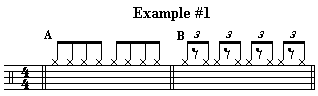
Whenever you read a jazz drum part, any eighth-notes (see example #1A) have to be interpreted as eighth-note
triplets, as shown in example #1B.
Therefore, the standard jazz ride cymbal pattern of dotted eighth-note followed by sixteenth-note (example #2A) is interpreted as shown in example #2B.
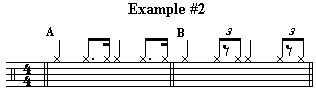
In other words, jazz interpretation tells you to play all patterns with a triplet feel. This gives them a nice, rolling jazz feel that falls somewhere in between straight eighth-notes and the overly mechanical sounding dotted eighth-note followed by sixteenth-note pattern.
Although I've written the exercises in this lesson in dotted eighth-note/sixteenth-note form, you should use jazz interpretation to play them as if they were written as eighth-note triplets. More often than not, this is the way you will see them written in actual drum charts so you might as well get used to interpreting them now. (You will also see them written as straight eighth-notes in actual drum charts.)
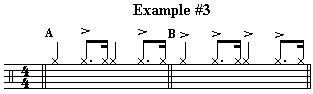
Example 3A shows the basic jazz ride cymbal pattern. Although some drummers play this pattern with an accent on the beats of two and four, you'll find that it swings more with a slight accent on each of the beats of one, two, three, and four as shown in example 3B.
Before you begin working on four-way coordination, I strongly suggest that you practice playing the ride cymbal pattern alone. Try to get a good feel for it and make it swing all by itself, before you attempt to add your snare and feet to the mix. You'd be surprised at how many drummers have never learned to get a good, swinging sound from this basic jazz ride cymbal pattern.
Once you've developed a swinging right hand ride pattern, the next step is to play some patterns against it with your left hand on the snare.
Adding The Left Hand
Once you've developed a swinging right hand ride pattern, the next step is to play some patterns against it
with your left hand on the snare. (Note: I included right and left hand designations for simplicity sake, feel
free to reverse them if you play the ride cymbal with your left hand.) Take a look at example #4 below.
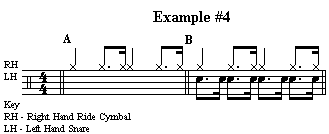
Start by playing the jazz ride cymbal pattern alone (example #4A) and then add the left stick snare part (example #4B). Try to get to the point where you can "hear" the two sounds separately instead of hearing them together as one sound. If you can develop this ability, you'll find it much easy to play anything that comes to mind without first having to break it down in practice. This is the best way to develop your four-way coordination.
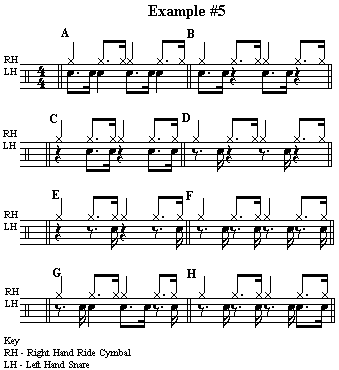
Practice the remainder of the exercises in example #5 below. Always start each new exercise by playing a
couple bars of ride cymbal "time" before attempting to play the snare part. Each time you come to a
new exercise, concentrate on hearing two distinct parts.
For Further Study
This week I'd like you to work on perfecting your two-way coordination, until you can easily play any
combination that comes to mind.
For more exercises, play the first two sections of Jim Chapin's book Advanced Techniques for the Modern Drummer.(See the Related Links sidebar.) You should also repeat the exercises on this page (and those in Jim's book) reversing the sticking. That is, playing the standard jazz ride cymbal pattern with your left hand and the snare pattern with your right hand (or vice versa if you already practiced it the opposite way).
If you really want to develop good jazz chops you need to become comfortable playing all of the right hand jazz ride cymbal variations, not just the basic pattern shown here and in Chapin's book.
For extra study, take each bar of pages 12 and 13 in Ted Reed's Syncopation book (See Related Links sidebar) and apply them to all of the left hand exercises both on this page and in Chapin's book. Once you can do this with ease, it'll be time for you to add your feet to the mix.
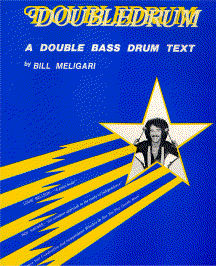
For those of you who really want to get into it, check out my book, DoubleDrum: A Double Bass Drum Text (see sidebar). Don't let the title fool you. By substituting your hi-hat for the second bass drum, you'll be able to hone your four-way coordination to perfection.
But don't get ahead of yourself. First, develop solid two-way coordination. In the conclusion of Four-Way Jazz Chops (see sidebar), we'll add three- and four-way coordination.
Until next time: Stay loose
Stay Tuned for the re-release of Tiger Bill's Classic Double Bass Drum Text: DoubleDrum - Coming Soon!
Click the following link for Four-Way Jazz Chops: Part 2!